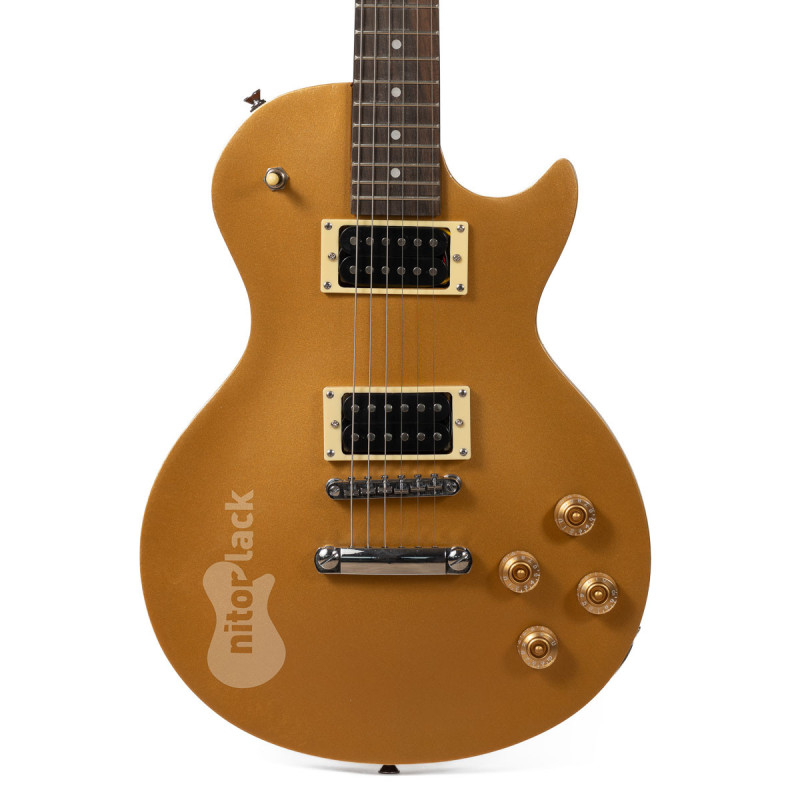


Production of the Gibson Les Paul Standard with Goldtop finish began in 1952
and continued through 1958. During this period, Les Paul Standards featured
a Goldtop maple top and mahogany body. These guitars are highly valued by
collectors and vintage guitar aficionados.
This color has been modified over time, deriving in two clearly differentiated
tones. The “AGED GOLDTOP” has a more aged appearance, with a darker or
“toasted” tone.
 Security policy
(edit with the Customer Reassurance module)
 Delivery policy
(edit with the Customer Reassurance module)
 Return policy
(edit with the Customer Reassurance module)
All about Goldtop color:
The Gibson guitar in “Goldtop” color has been manufactured in different models and series over the years.
However, one of the most emblematic models with Goldtop finish is the Gibson Les Paul Standard.
Production of the Gibson Les Paul Standard with Goldtop finish began in 1952 and continued until 1958.
During this period, Les Paul Standards featured a maple top in Goldtop finish and mahogany body.
These guitars are highly valued by collectors and vintage guitar aficionados.
After 1958, Gibson stopped producing Les Paul Standard with Goldtop finish and started using other
finishes such as Sunburst.
However, in subsequent years, Gibson has released reissues and Goldtop versions of the Les Paul Standard,
including limited production models.
During these years there may be differences in the color shades of the Goldtop finish of Gibson Les Pauls
manufactured during these years.
This is due to several factors, such as the manufacturing process, the materials used and the natural aging of the guitar.
Differences between Aged goldtop and goldtop:
During the early years of production of Les Paul Standard guitars with Goldtop finish (1952-1958), there were variations
in color tone due to differences in the application of the varnish and the selection of the maple used in the top.
Some Goldtop guitars had a lighter and brighter tone, while others could be more dark and tan or have a yellowish hue (aged).
In addition, the passage of time, exposure to light and other environmental factors can affect the tone of the Goldtop
finish on a vintage guitar. Many Gibson Les Paul Standards made in that era have acquired a wear and aging pattern
known as “crazing” that can affect the appearance of the original color.
It is important to note that, in modern reissues and current Goldtop versions, Gibson has tried to replicate the tones and
characteristics of the original 1950s models. However, there may always be slight variations in color due to different
manufacturing processes and the effects of artificial aging.
With the new Aged GoldTop color we wanted to replicate the more toasted and caramel goldtop tone, thus completing
Gibson’s full range of goldtop colors.
Production of the Gibson Les Paul Standard with Goldtop finish began in 1952
and continued through 1958. During this period, Les Paul Standards featured
a Goldtop maple top and mahogany body. These guitars are highly valued by
collectors and vintage guitar aficionados.
This color has been modified over time, deriving in two clearly differentiated
tones. The “AGED GOLDTOP” has a more aged appearance, with a darker or
“toasted” tone.